


By Ken Stauffer, Co-Founder IEEE Entrepreneurship & IEEE Entrepreneurship Workshops.
I have no special talents.
I am only passionately curious”.
–Albert Einstein
I have two big passions (Africa and Entrepreneurship) because I was born and raised in Tanzania, and I’ve been a serial entrepreneur since I left the former AT&T Bell Labs in 1999. Our idea for the IEEE Entrepreneurship Workshops originated in 2016, when Rakesh Kumar and I were tasked with developing a half-day entrepreneurship tutorial for the IEEE PowerAfrica Conference in Zambia. (See footnote below)
A Spark: A Mission Born in Africa
After that great Zambia experience, we came away wanting to create and develop richer and more meaningful workshops that would encompass several days and that would really give STEM people the tools needed to develop their ideas into sustainable businesses. We were interested in developing a program that supported most of our entrepreneurial members, rather than just creating another IEEE event or the ever-present half-day pitch competitions dominating our ecosystem.
When Gordon Day, an IEEE Past President, heard our idea, he told me not to reinvent the wheel; that someone named Dr. Surya Raghu had done similar workshops at the International Center for Theoretical Physics (ICTP) in Trieste, Italy. Raghu and I had a call in 2017 and discovered that we shared the same vision, passion, and ideas for educating entrepreneurs. We joined forces in 2018 in Rwanda and again in 2019 in Uganda, with IEEE co-funding those East African workshops along with the ICTP and the Institute of Physics (UK).
A Sustainable Model: Targeting the Entrepreneurial Ecosystem
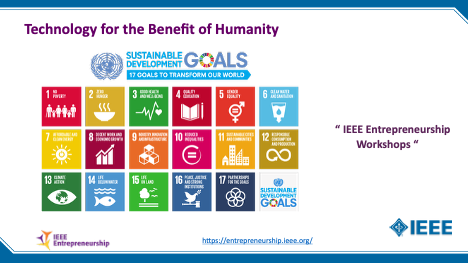
In 2019, the Physics organizations decided not to continue the workshops and stopped their funding. That’s when we decided to write a 3-year IEEE New Initiative Committee (NIC) proposal to fund IEEE Entrepreneurship Sustainable Development Workshops for disadvantaged areas in Africa and South America, focused on implementing the UN-SDGs using ideas and technology that the attendees proposed.
We aimed to develop a sustainable program that benefits the majority of our IEEE Entrepreneurship ecosystem. Our 2020 IEEE Entrepreneurship survey revealed that approximately 71% of the members in our ecosystem consisted of academic research start-ups (23%), aspiring entrepreneurs (22%), and established start-up entrepreneurs (26%). About 12% were growth and scaling entrepreneurs, and the rest (7%) were investors, governments, accelerators, etc., as explained in the 2021 IEEE Potentials Magazine article.
Our “Introductory” IEEE Entrepreneurship Workshops (ENT 101) are targeted at the 71% who know STEM but lack knowledge of business models, customers, products, markets, and finance. In 2024, we added an “Advanced” Workshop (ENT 102) for those entrepreneurs who have founded a start-up and need to take it to the next step. The Workshops are taught by entrepreneurs who have founded multiple start-ups and “have scars on their backs to prove it”
Scaling Up: The Power of Funding and Strategic Partnerships
I didn’t know much about NIC in 2019 when I wrote the proposal, but thankfully, our request for IEEE Entrepreneurship Workshops got funding of $100,000 over 3 years. Our request anticipated 8 workshops over 3 years with $125,000 of co-sponsors’ revenue. Due to COVID, we didn’t start until 2021, when we conducted two virtual workshops via Webex in Africa and South America. We started face-to-face workshops in 2022, and by the end of 2025, we will have conducted 18 IEEE Entrepreneurship Workshops in IEEE Regions 1,8,9, and 10 over the 5 years, with total NIC and co-sponsor revenues of $370,000.
Like many start-ups, we had to pivot in 2022 after realizing that our initially identified co-sponsors were not viable. We focused on global and regional organizations, including SmartAfrica, FIOCRUZ, UNESCO, Afretec, Wits University, and SENACYT. IEEE Corporate and IEEE TAB also provided funds for a total co-sponsorship of $150,000, with IEEE Entrepreneurship providing $120,000 over 4 years.
The “Marketplace of Ideas”: Inside an Introductory Workshop
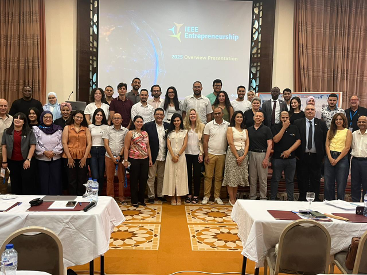
Each Introductory IEEE Entrepreneurship Workshop (Ent 101) has approximately 40 selected attendees who come to a University, Conference Center, or hotel for 3-5 days and work in 8 teams of approximately 5 people to develop a business idea that they propose. We call it the “marketplace of ideas,” where the people with ideas for a start-up need to get 4 other team members to join them. During the Worksho,p we discuss developing the business model, the value proposition, target customers and markets, the competition, and the finances needed to get started. We invite local intellectual property experts, local entrepreneurs, and investors to talk so that the attendees are acquainted with the local start-up ecosystem. At the end of the workshop, the teams present their pitches in a competition that demonstrates what they learned, and a winner is selected.
Long-Term Success: Astounding Impact and a Sustainable Future
Just like any start-up, NIC ‘s long term goal is sustainability, so, our goal was to make these NIC workshops a long-term program, preferably situated in IEEE Entrepreneurship. And we have achieved those goals. In 2025, IEEE Entrepreneurship stepped up with $40,000 of funding for the IEEE Entrepreneurship Workshops ENT 101 and ENT 102, and agreed to fund them as a long-term IEEE Entrepreneurship program.
The impact of our workshops, spanning 5 years and 18 sessions, has been astounding! We had several thousand applicants from which we selected about 800 attendees. We marketed IEEE Entrepreneurship as a great way to get involved with IEEE and showed that IEEE is entrepreneurial in its thinking, not just technical. We supported the IEEE Regions, IEEE Sections, and IEEE Societies, and exposed many non-IEEE participants to the benefits of joining IEEE. We have built strong partnerships with regional and global co-sponsors who view IEEE as a key partner in their efforts. And we are making a sustainable impact in the world, because we focus on the UN-SDGs in our workshops! We’ve had an attendee satisfaction score of 4.6 overall out of a possible 5.0, a would recommend score of 4.7 out of a possible 5.0, a skill level before workshop of 3.1 out of a possible 5.0, and a skill level after workshops of 4.25 out of a possible 5.0 – so we made a difference!
We’d like to thank everyone involved in making our IEEE Entrepreneurship Workshop program successful, and for the generous support from those who believed in our vision and funded our start-up – IEEE NIC, our global and regional co-sponsors, and IEEE Entrepreneurship! But the real secret to our success is the tireless support we got from the IEEE Entrepreneurship staff since 2019 (Randi Sumner, Tom Monaco, Caitlin Zubrowski, and Lauren Beighley), who are our “secret sauce”.
There is a Swahili saying, “Ukitaka kwenda kasi, nenda peke yako. Ukitaka kwenda mbali, nendeni pamoja” “If you want to go fast, go alone. If you want to go far, go together.”
And we want to keep going far!