

By Luis Miguel Silveira, CEDA President, and Sri Parameswaran, Vice President, Publicity, CEDA
When the IEEE Council on Electronic Design Automation (CEDA) was founded in 2005, the EDA world looked very different. Multi-billion-transistor chips were still a distant dream, AI was a research curiosity, and the challenges of system-level design and verification were just beginning to take center stage. Fast-forward to 2025: chips now pack tens of billions of transistors, AI accelerators dominate roadmaps, and EDA has become the indispensable engine powering the semiconductor revolution.
This year, CEDA marked its 20th anniversary, commemorating the milestone with a series of high-profile events, special publications, and community initiatives designed not only to celebrate past achievements but also to chart the course for the future.
Anniversary Panels Across the Globe
The centerpiece of CEDA’s 20th anniversary was a series of global panels hosted at major international conferences, including ASP-DAC, DATE, DAC, and ICCAD, each highlighting CEDA’s global influence and continued leadership in electronic design automation.
- ASP-DAC 2025 (Tokyo, Japan)
The ASP-DAC 2025 panel titled ‘Past, Present, and Future of EDA’ explored how Asia’s EDA ecosystem is transitioning from manufacturing excellence to design innovation. Panelists Prof. Yao-Wen Chang (National Taiwan University, Taiwan), Prof. Kwang-Ting Cheng (Hong Kong University of Science and Technology, Hong Kong), Prof. Shinji Kimura (Waseda University, Japan), and Prof Jeong-Taek Kong (Sungkyunkwan University, Republic of Korea) discussed attracting new talent, bridging academia and industry, and adapting EDA research to an AI-centric era. The discussion emphasized the importance of collaboration, open platforms, and cross-disciplinary education to sustain innovation over the next 20 years.
- DATE 2025 (Grenoble, France)
The DATE 2025 panel, ‘Designing the Future: 3D Integration, Open EDA, and Sustainable Systems’, examined Europe’s leadership in mission-driven EDA research. Chaired by Prof. Georges Gielen, it brought together Prof. Rolf Ernst (TU Braunschweig, Germany), Prof. David Atienza (EPFL, Switzerland), Prof. Valeria Bertacco (University of Michigan, USA), and Prof. Luca Benini (ETH Zurich / University of Bologna, Italy) to discuss current topics. Discussion focused on 3D integration, open-source tools, and sustainability, identifying ‘green EDA’ and open collaboration as central to the next decade of progress. The panel underscored Europe’s coordinated efforts as a model for global cooperation.
- DAC 2025 (San Francisco, USA)
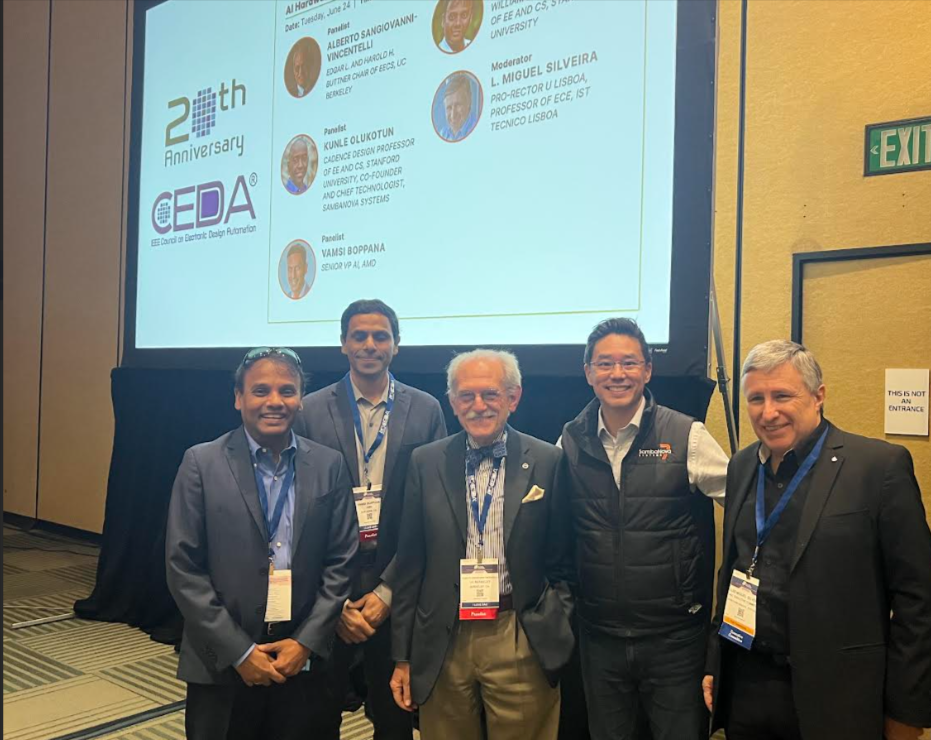
At DAC 2025, the panel ‘EDA in the Age of AI, Cloud, and Ubiquitous Computing’ brought together leading voices from academia and industry, including Prof. Alberto Sangiovanni-Vincentelli (University of California, Berkeley), Dr. Vamsi Boppana (Senior Vice President, AMD), and Mr. Rodrigo Liang (CEO, SambaNova Systems). The panel was moderated by Prof. Subhasish Mitra (Stanford University) and Prof. L. Miguel Silveira (Instituto Superior Técnico, Universidade de Lisboa). Discussions focused on AI-driven design, cloud-based workflows, and human-AI collaboration in verification and layout. Panelists concluded that EDA has evolved from a supporting role to being the strategic enabler of the AI revolution, requiring tighter integration between algorithms, scalable compute, and open ecosystems.
- ICCAD 2025 (Munich, Germany)
The ICCAD 2025 panel ‘From Past to Future: 20 Years of EDA Wisdom and What’s Next’ concluded CEDA’s 20th anniversary celebrations by reflecting on EDA’s evolution and future directions. Moderated by Prof. Robert Wille (TU Munich) and Prof. Miguel Silveira, the discussion, featuring panelists Prof. Yao-Wen Chang, Dr Sani Nassif (Radyalis), Prof. Subhasish Mitra, and Prof. Ulf Schlichtmann (TU Munich), reviewed breakthroughs and missed opportunities in EDA, and examined how AI, quantum, and emerging technologies will redefine the field. The key takeaway is that EDA’s next era will rely on blending human insight with intelligent automation and cross-disciplinary collaboration.
Publishing for Posterity
True to its mission of advancing knowledge, CEDA also turned to its publishing arm to mark the occasion. Plans were set in motion for a special issue of IEEE Design & Test, featuring retrospective pieces from leading figures in the EDA community, alongside forward-looking essays on emerging areas like quantum EDA and AI-driven verification. Guest editors Prof. Joerg Henkel and Prof Miguel Silveira are curating the issue, ensuring it balances historical perspective with provocative visions of what’s next.
Logos, Branding, and a Community Spirit
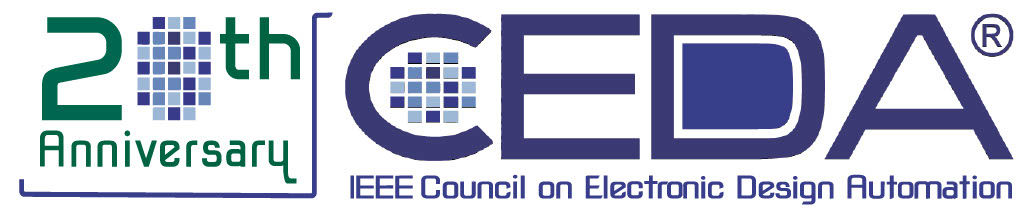
No anniversary would be complete without a touch of style. CEDA commissioned a commemorative logo to brand its 20th-year activities, reinforcing visibility across newsletters, websites, and conference backdrops. The familiar CEDA Currents newsletter also dedicated special sections to the anniversary, featuring reflections, interviews, and photo retrospectives.
Looking Back, Looking Ahead
In just two decades, CEDA has matured from a fledgling council to a global force uniting multiple IEEE societies and connecting thousands of researchers, practitioners, and educators. Its 20th anniversary celebrations were more than a retrospective—they were a reminder of the community’s vitality, resilience, and ambition.
As panelists noted across ICCAD, DAC, DATE, and ASP-DAC, the challenges facing EDA today are every bit as daunting as those that inspired CEDA’s creation: design complexity, power efficiency, security, and now the integration of AI and quantum. If the past 20 years are any guide, CEDA will not only help the community rise to these challenges but also ensure that the story of electronic design automation continues to be one of innovation, collaboration, and impact.